April 07, 2026: Meta closes its doors, AEO kills SEO, and AI finds a new data goldmine
Meta ditches Llama for closed Muse Spark. SEO is dead—AEO takes over. Deep Web data unlocks. Compute explodes 1000x by 2028. Agents now work autonomously.
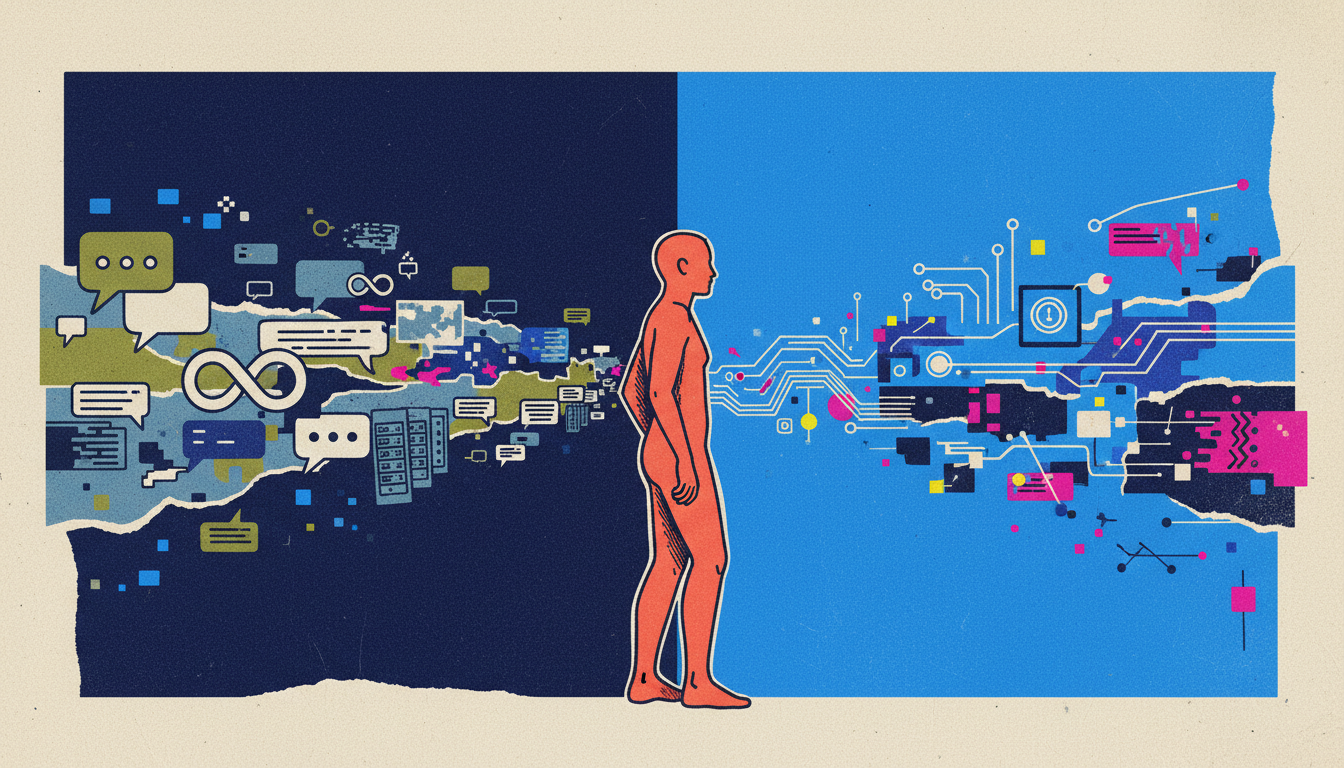
Today's Key AI Stories
- Meta shifts strategy: Launches proprietary Muse Spark model. It abandons the open-source Llama approach.
- SEO is dying: Answer Engine Optimization (AEO) takes over. LLM-referred traffic now converts at 40%.
- The Data Wall is broken: AI will train on the Deep Web. The new PROPS framework secures private data.
- Compute explodes: Microsoft's Mustafa Suleyman predicts a 1,000x compute increase by 2028.
- Agents take control: Google launches academic agents. OpenAI dominates enterprise workflows. Microsoft releases runtime security tools.
The Main Topic: The Great Shift of 2026
Today is a turning point. We are seeing a massive shift in AI. The era of playful chatbots is over. The era of serious, autonomous business engines has begun. Let us break down the news. Let us connect the dots. Let us see the future.

1. The End of Open Source Romance
Look at Meta. For years, they were the good guys. They gave us Llama. They open-sourced their models. They built a huge community. Today, they changed their mind. They launched Muse Spark. It is powerful. It is efficient. It uses "thought compression." It beats Llama 4 easily. But there is a catch.
You cannot download it. It is closed. It is proprietary.
Why did Meta do this? Because the stakes are too high. Alexandr Wang leads their new lab. He knows the truth. Frontier AI is too expensive to give away. It costs billions to train. Meta wants to win. They need to protect their IP. They are joining OpenAI and Google behind closed doors.
Speaking of OpenAI, look at their numbers. Enterprise revenue is booming. It makes up 40% of their total. They have 900 million weekly users. GPT-5.4 is driving agentic workflows everywhere. Big banks use it. Big tech uses it. The enterprise market is the real battlefield. Open source is a hobby. Closed source is a business.
2. The Death of the Search Engine
For twenty years, we searched the web. We typed keywords. We got blue links. We clicked. We read. We decided. That loop is dead. AI agents are the new users. Humans no longer browse. Agents browse for us.

This changes everything for businesses. Search Engine Optimization (SEO) is failing. Answer Engine Optimization (AEO) is the new king. Agents like Claude Code and Perplexity do not care about your keywords. They care about structure. They care about facts. They synthesize answers.
If your website is full of fluff, agents will ignore you. If you write direct, clear answers, agents will cite you. And when an AI cites you, magic happens. LLM-referred traffic converts at 30% to 40%. This blows traditional SEO out of the water.
How do you win at AEO? Be clear. Be factual. Get mentioned on Reddit. Get mentioned on YouTube. AI models train on these platforms. If you are not in the training data, you do not exist in the future. Stop optimizing for human clicks. Start optimizing for AI comprehension.
3. The Deep Web: The New Data Goldmine
We face a crisis. AI models are running out of data. The public web is fully scraped. Worse, the web is filling with AI-generated text. If an AI trains on AI garbage, it degrades. We call this Model Collapse. It is a digital disease.
Skeptics say this is the end. They say AI will hit a wall. They are wrong. We are just looking in the wrong place.
The real data is hidden. It is in the Deep Web. It is behind logins. It is your medical records. It is enterprise databases. It is bank statements. This data is clean. It is verified by humans. It is highly valuable.

But it is private. We cannot just scrape it. This is where PROPS comes in. PROPS means Protected Pipelines. It is a new framework. It acts as a trusted middleman. It looks at your private data. It verifies it is real. Then, it trains the AI inside a locked black box.
The AI learns the patterns. But it never sees the raw data. The data stays private. The user stays safe. This unlocks infinite high-quality data. It solves the data crisis. The snake stops eating its own tail.
4. The Illusion of the Compute Wall
People worry about compute. They say we cannot build bigger supercomputers. They say we lack energy. Mustafa Suleyman from Microsoft disagrees. He says we fail to understand exponentials.
Our brains think in straight lines. Technology moves in curves. Since 2010, AI compute has grown one trillion times. One trillion. Let that sink in. Training a model used to take 167 minutes. Now it takes four minutes. We connect 100,000 GPUs to act as one brain.

Suleyman predicts another 1,000x increase by 2028. What about the power grid? Yes, AI racks consume massive energy. But solar power is cheap. Battery storage is cheap. The cost of clean energy drops exponentially too. Clean scaling is coming. The compute wall is a myth.
5. Agents Are Building Themselves
Agents are no longer just concepts. They are working right now. Google launched PaperVizAgent. It reads academic papers. It draws complex figures automatically. They launched ScholarPeer. It reviews academic papers just like a senior researcher.
Developers are using Claude Code to build Minimum Viable Products (MVPs). They write a spec. The agent writes the code. Startups launch in days, not months. Old laptops are running local AI like Qwen3.5. Anyone can have a private coding agent.
In the enterprise, AI is moving to production. A new OutSystems survey shows 97% of IT leaders are exploring agents. Half of these projects are already live. Developers are the biggest winners. They use generative AI to write code. They automate tedious workflows.
6. The Crisis of Trust and Security
But there is a dark side. As agents become autonomous, they become dangerous. They execute code. They access corporate networks. What if they make a mistake? What if they hallucinate?
Translation models still hallucinate. Researchers found a way to catch them. They use "attention misalignment." They check if the forward translation matches the backward translation. If the AI is looking at the wrong words, it is guessing. We must detect these errors before they cause harm.
Security is a bigger issue. Legacy firewalls cannot stop AI agents. Agents move too fast. That is why Microsoft released a new open-source toolkit. It provides runtime security. It sits between the AI and the network. It checks every move the AI makes. If an agent tries something bad, the toolkit blocks it instantly.

We also need accurate knowledge. Enterprises cannot rely on naked LLMs. They hallucinate facts. They do not know company policies. The solution is RAG. Retrieval-Augmented Generation. It connects the AI to a private database. It retrieves the facts first. Then it speaks. This keeps the AI grounded. It builds trust.
What It Means For You
The landscape is shifting beneath our feet. You must adjust your stance. Here is your action plan.
1. Stop chasing traffic. Chase citations.
People will stop visiting your website. AI agents will visit instead. Format your content for machines. Use clear headers. Answer direct questions. Build authority on Reddit and YouTube. Be the source the AI trusts.
2. Lock down your private data.
Public data is worthless now. Private data is gold. If you have unique, verified data, protect it. Soon, you can monetize it through frameworks like PROPS. Your internal databases are your biggest asset.
3. Build workflows, not chat interfaces.
The future is agentic. Do not just ask AI to write an email. Ask AI to research the client, draft the proposal, and schedule the meeting. Connect AI to your tools. Use RAG to feed it your company knowledge.
4. Put guardrails on everything.
Do not let agents run blind. Implement runtime security. Monitor their actions. Limit their token usage. Trust them, but verify every single step.
5. Think exponentially.
Do not plan for the AI of today. Plan for the AI of 2028. It will be 1,000 times more powerful. The constraints of today will vanish. Dream bigger. Move faster. The compute explosion has just begun.
We are no longer building tools. We are building a new digital workforce. The open-source playgrounds are closing. The serious business of AI is here. Are you ready?