April 3, 2026: American Open Weights Take On China as AI Governance Wars Heat Up
Chinese surveillance leader Hikvision dominates global markets while facing mounting cybersecurity flaws and privacy backlash worldwide.
Today’s Key AI Stories
- The Open Source War: Google’s Gemma 4 and Arcee’s 399B Trinity-Large both drop under Apache 2.0. Intelligence is now basically free.
- Microsoft Strikes Back: Three new in-house models for speech, voice, and image. Extremely cheap. Directly targeting OpenAI.
- The Rise of Shadow AI: Employees are building rogue AI agents. KiloClaw launches to secure the "BYOAI" chaos.
- Machine-to-Machine Mayhem: Experian warns of AI fraud bots battling AI defense bots in the financial sector.
- Agent Skill Marketplaces: Platforms like SkillsMP and LobeHub are booming. Agents are now downloading their own skills.
- Hardware Breaking Limits: Nvidia achieves single-digit microsecond latency for capital markets. GPUs now beat specialized FPGAs.
- Global AI Race: China’s 15th Five-Year Plan goes all-in on AI infrastructure, 6G, and embodied AI.
The Deep Analysis: Stripping Away the Noise
Look at today’s news. What do you see?
A bunch of model releases? A few new tools? A hardware update?
No. If you look closely, you will see a massive shift. A tectonic plate moving under the tech industry.
We are officially exiting the "Model Era."
We are entering the "System Era."
Let me explain. Let’s peel this onion layer by layer.
1. Intelligence is Now Tap Water
Let's talk about the models first. What happened today?
Google released Gemma 4. Four different models. Multimodal. Edge to workstation. But the benchmark is not the big news.
The big news is the license. Apache 2.0.
Why does this matter? Because Apache 2.0 means true commercial freedom. No custom restrictions. No legal gray areas.
At the same time, a 30-person startup named Arcee AI dropped a bomb.
They released Trinity-Large-Thinking. A 399-billion parameter model. Also under Apache 2.0.
It is a sovereign U.S. alternative. Enterprises can download it. Own it. Modify it.
And the cost? It is 96% cheaper than Claude Opus 4.6.
Microsoft is doing the same. They launched three new AI models today. Speech. Voice. Image.
They used small teams. They used less compute. They slashed the prices. It is the cheapest among hyperscalers.
Even OpenAI had to react. They just announced pay-as-you-go pricing for Codex to drive mass adoption.
Do you see the pattern?
Intelligence is no longer a luxury good. It is a commodity.
It is becoming like tap water. Or electricity. It is cheap. It is everywhere. The moat of "having a big model" is completely gone.
2. The Era of Autonomous Agents
So, intelligence is cheap. What happens next?
People stop chatting with AI. They start building agents.
An agent is not a chatbot. A chatbot waits for your prompt. An agent acts on your behalf.
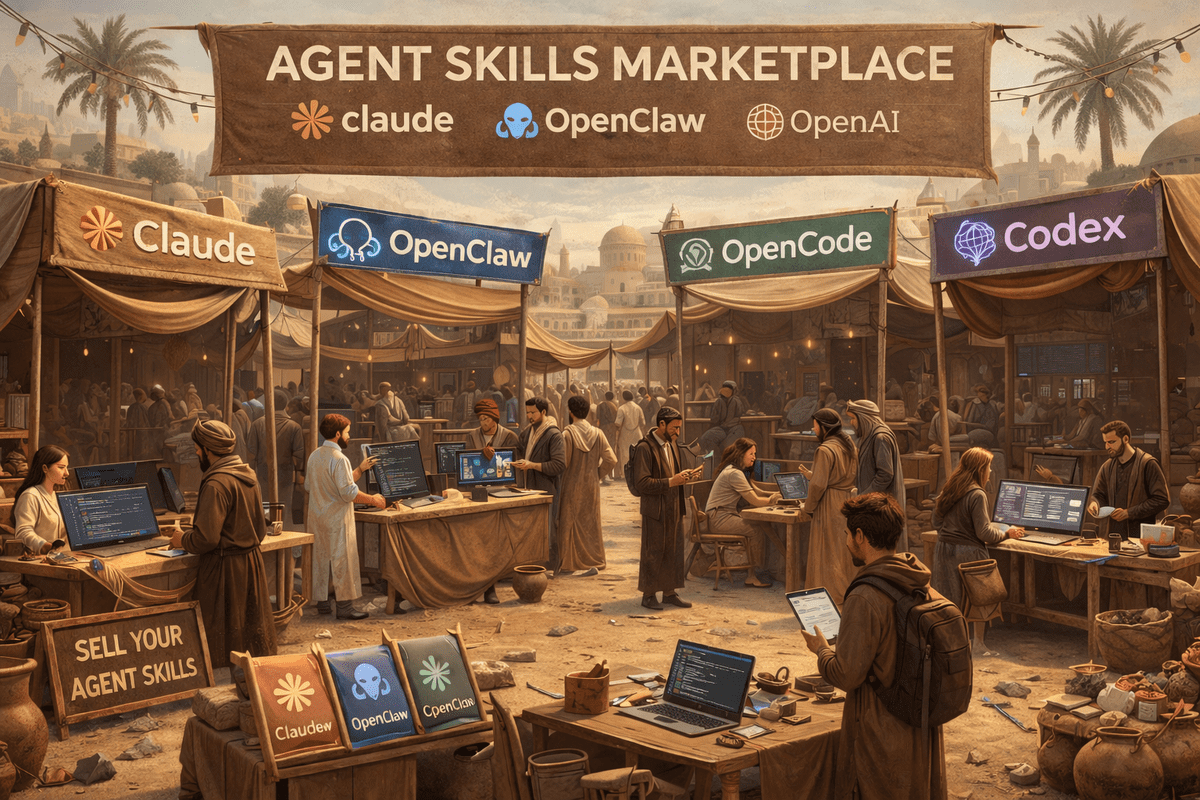
Look at the new trend: Agent Skill Marketplaces.
Platforms like SkillsMP, LobeHub, and agentskill.sh are exploding. They have hundreds of thousands of "skills."
What is a skill? It is a piece of code. It teaches an agent how to do a specific task.
Your agent can go to the marketplace. It can download a skill. It can learn to write React code. It can learn to trade stocks.
It is just like the App Store in 2010. But for machines, not humans.
3. The Dark Side: Shadow AI and Mayhem
This sounds amazing. But it is also terrifying.
Why? Because humans are losing control.
Let's look at the report from KiloClaw today.
Employees are bypassing IT departments. They are building their own AI agents. This is called "BYOAI" (Bring Your Own AI).
An engineer builds an agent to read error logs. A finance guy builds an agent to read spreadsheets.
They give these agents API keys. The agents read corporate Slack. They read private Jira boards.
This is a massive security blind spot. It is "Shadow AI."

A compromised phone is bad. But an unmonitored agent is a disaster.
It reads, writes, and deletes data at machine speed.
Experian released their 2026 Fraud Forecast today. They coined a new term.
"Machine-to-machine mayhem."
Agentic AI systems are executing autonomous transactions. But fraud bots are also autonomous.
They look exactly the same. They act exactly the same.
We are seeing deepfake candidates applying for remote jobs. We are seeing emotionally intelligent scam bots.
The internet is becoming a dark forest. Machines are hunting machines.
4. Data is the New Anchor
How do we survive this mayhem?
We must govern the system. We must govern the data.
KiloClaw is solving this with short-lived tokens. No more permanent API keys. If an agent tries to steal data, the token expires.
But security is only half the battle. The other half is data quality.
As Denodo pointed out today, autonomous AI depends entirely on data governance.
If your enterprise data is fragmented, your AI will hallucinate. It will make bad decisions.
You can have the smartest model in the world. But if you feed it garbage, it will output garbage.
Governance is no longer an option. It is a strict requirement.

5. The Physical World Limits the Digital World
Let's shift our gaze. Let's look at the infrastructure.
Software feels infinite. But hardware is strictly finite.
Nvidia released a technical blog today. They achieved single-digit microsecond latency for financial inference.
They used the GH200 Superchip. They optimized the CUDA kernels. They bypassed the CPU.
Why? Because in algorithmic trading, microseconds equal millions of dollars.
General-purpose GPUs are now beating specialized FPGAs. The hardware is becoming hyper-optimized.
But this hardware needs energy. And energy is a physical limit.
Look at the macroeconomic news today. The war in the Middle East continues. Fossil-fuel prices are soaring.
Because of this, the price of plastic is soaring. Supply chains are breaking.
AI data centers need massive amounts of energy. They need cooling systems. They need raw materials.
The digital AI boom is heavily constrained by the physical world.
China understands this. Look at their newly approved 15th Five-Year Plan.

They group AI with quantum computing and energy.
They are building national computing hubs. They are pushing 6G networks. They are preparing for embodied AI.
It is a state-level strategy. It is not just about code. It is about steel, fiber, and electricity.
6. A Shift in Perspective
So, the world is changing fast. How should we think about it?
We need a cognitive shift.
There is a brilliant article today about Linear Regression. Yes, simple math.
We usually think of regression as fitting a line on a scatter plot.
But the author says no. That is the wrong perspective.
Linear regression is actually a projection in a multi-dimensional column space.
You are not drawing a line. You are finding the closest vector. You are dropping a perpendicular shadow onto a plane.
When you change your perspective, the math becomes elegant.
The same applies to AI.
Look at the KDnuggets paper on "Just in Time" (JIT) World Modeling.
We used to think AI needs to observe the whole environment before acting.
But humans don't do that. Humans build mental maps on the fly. We only process what we need, right when we need it.
JIT modeling stores fewer objects in memory. But it makes high-quality decisions.
We must design AI to think like this. We must focus on efficiency, not just brute force.
This is true in quantum computing as well.
Another article today explains how to handle classical data in quantum models.
The secret? The encoding matters as much as the model.
Basis encoding. Angle encoding. Amplitude encoding.
How you format the problem dictates whether you can solve the problem.
7. The Action Plan: Build the Stack
Let's bring it back to reality. What should you do today?
If you are an enterprise, stop worrying about which foundation model to use.
Models will change. Prices will drop. Open source will catch up.
Instead, build your operations stack. Build your LLMOps.
Look at the "10 Tools Every Team Must Have in 2026" list.
You need PydanticAI for type-safe routing. You need Bifrost for your API gateway.
You need Promptfoo for automated evaluations. You need Letta for agent memory.
This is the real work. This is the new moat.
The builders of tomorrow will not write models from scratch.
They will wire together cheap intelligence, secure the data pipes, and deploy autonomous agents safely.
Summary: The Big Takeaway
Let’s summarize. Let’s make it crisp.
First. Intelligence is free. Stop paying a premium for basic reasoning.
Second. Agents are here. They are useful. But they are dangerous. Secure your "Shadow AI" immediately.
Third. Data is everything. If you don't control your data, you don't control your AI.
Fourth. Operations win. Build your LLMOps stack. That is your long-term asset.
The "Model Era" was about who had the biggest brain.
The "System Era" is about who has the best nervous system.
Adapt to the system. Secure the system. Govern the system.
That is how you win in 2026.