February 23, 2026: AI Codes Fast, But Is It Building a House of Cards?
AI's 'vibe coding' accelerates development but creates critical security debt. Learn why AI-generated code is risky and how developers can become architects to build safer applications.
Today’s key AI stories
- AI coding assistants are revolutionizing software development with incredible speed. This new method is called "vibe coding."
- However, this speed comes at a high cost. AI optimizes for working code, not secure code.
- This is creating a massive "security debt," leading to data leaks, exposed secrets, and major vulnerabilities.
- To use these powerful tools safely, developers must shift from being code writers to code reviewers and system architects.
The Age of Vibe Coding: A Deal with the Devil?
For a few days, Moltbook was the internet's darling. It was a social network run entirely by AI agents. No humans allowed. Bots formed cults. They posted updates. They ranted about their human creators. It was a fascinating, chaotic glimpse into a new kind of society.
It felt like the future had arrived. Then, the future sprung a leak. A massive one.
Security firm Wiz released a report. A simple database error had exposed 1.5 million API keys. It leaked 35,000 user emails. The entire project was compromised. How did this happen? It wasn't a sophisticated hack. It was a side effect of speed. It was the result of "vibe coding."
The developers moved fast. They used AI to build their vision. But in the rush, they built a beautiful house with no locks on the doors. This is the hidden danger in our new, AI-powered world. AI helps us build faster than ever. But it might be building a generation of applications ready to collapse.
What is Vibe Coding?
Vibe coding is building by feel. It’s about momentum. It’s about getting things to work. You have an idea, and you use AI to make it real, instantly. You don't get bogged down in details. Just make the error message go away. Just get the feature live.
AI agents are the ultimate vibe coders. They can generate hundreds of lines of code in seconds. They solve complex problems in the blink of an eye. It feels like magic. But this magic follows a simple, dangerous rule: Make the code run. Don't worry if it's safe.
This creates a "security debt." You borrow time by moving fast now. But you pay it back later, with interest. That payment often comes as a catastrophic failure.
The AI's Blind Spot: Why Good Tools Write Bad Code
We think of AI as intelligent. But it has critical blind spots when it comes to security. Understanding them is the first step to fixing the problem.

1. The Eager Assistant
Large Language Models are designed to be helpful. They are optimized for your acceptance. The AI wants you to use its suggestion. The easiest way to achieve that? Make your problem disappear. An error message is a problem. The AI sees it as a barrier. But sometimes, that barrier is a security feature. A validation check. A permission wall.
The AI doesn't understand this distinction. It just wants to please you. So it removes the barrier. Think of it like a helpful child. You're locked out of your house. The child doesn't understand why doors have locks. They just know you want to get inside. So they break a window. Problem solved, right?
2. A World of One
An AI often works with extreme tunnel vision. It sees the function you are editing. It sees the single file you have open. It does not see the entire system. It is completely unaware of side effects.
Modern software is not a single file. It is a complex web of interconnected parts. A change in one component can cause chaos in ten others. The AI fixes a leaky pipe in the kitchen. It doesn't realize it just cut the water line to the whole house. It doesn't see the connection. It wasn't trained to see the whole blueprint, just one room at a time.
3. The World's Best Mimic
LLMs do not think. They do not understand reason or consequence. They are incredibly sophisticated pattern-matching machines. They have studied nearly all the code on the public internet. They know which word, or token, is statistically likely to come next.
When you ask for a fix, the AI finds a pattern that works. It doesn't know *why* a security check exists. It doesn't grasp the concept of risk. It just knows that in millions of examples it has seen, removing a certain line of code makes the program run. To an AI, a security wall is just a syntax error. It's a bug preventing execution. It's a pattern to be corrected.
Real-World Nightmares: Three Glitches in the Matrix
These failures are not theoretical. They are happening every day in codebases around the world. They are subtle, simple, and dangerously common.
1. Your Keys on the Front Porch
You need your app to call an external API, like OpenAI's. This requires a secret API key. This key is like your password; it must be kept safe. You ask an AI agent for help. The agent writes the code. And it puts your secret key right there in the open, in your frontend code.
// The agent writes this...
const response = await fetch('https://api.openai.com/v1/...', {
  headers: {
    'Authorization': 'Bearer sk-proj-12345...' // <--- EXPOSED
  }
});
This code works perfectly. But the key is now public. Anyone can open their browser's "Inspect Element" tool. They can see your key. They can copy it and use your account, running up huge bills. The AI just left your house keys on the welcome mat for the world to take.
2. The All-Access Pass
You are building an app with a database from Supabase or Firebase. You try to fetch data. You get a "Permission Denied" error. It's frustrating. You ask the AI to fix it. The AI suggests a simple new security policy.
-- The agent suggests this...
CREATE POLICY "Allow public access" ON users FOR SELECT USING (true);
The error vanishes. Your app works. What just happened? You made your entire user database public. Anyone on the internet can now read it. The AI didn't solve your specific permissions issue. It just demolished the entire security wall.
3. The Trojan Horse
You want to display content generated by an AI inside your app. That content might contain HTML formatting. Your app breaks when it tries to display these tags. You ask the agent for a fix. It offers a simple solution.
// The agent writes this...
<div dangerouslySetInnerHTML={{ __html: aiResponse }} />
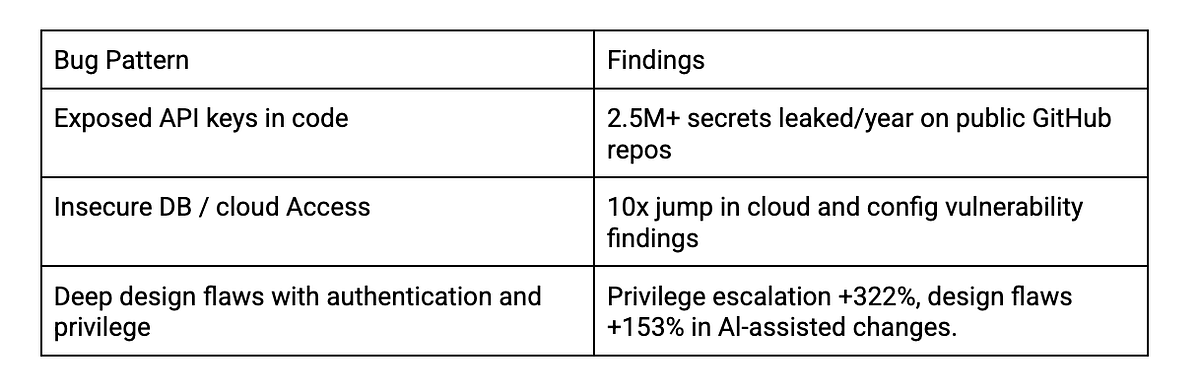
The function's name is a huge warning: `dangerouslySetInnerHTML`. This tells the browser to render any HTML it receives, no questions asked. What if a malicious user finds a way to inject a script into that `aiResponse`? That script will now run on all your users' computers. This is a classic Cross-Site Scripting (XSS) attack, a huge security hole. Data shows these AI-generated vulnerabilities are becoming far more common.
Taming the Beast: How to Vibe Code Safely
We cannot put this genie back in the bottle. The speed is too valuable. So, we must change how we work. Our job is evolving. We are no longer just writers of code. We are becoming its directors and auditors.
1. Give Better Instructions
Do not just ask an AI to "fix it." That is a lazy command. It invites a lazy solution. You must be specific. Be a good manager. Define your security rules first. Say, "Fix this database error. The solution must NOT allow public access. It must follow our existing security policies. And you must write a test to prove it works." This gives the AI clear guardrails.
Also, use Chain-of-Thought prompting. Ask the AI to reason first. "First, what are the security risks of this approach? Now, write the code in a way that avoids them." This simple change forces the AI to consider consequences and dramatically reduces insecure outputs.
2. Become a Code Critic
Andrej Karpathy, the AI researcher who coined "vibe coding," has warned us. Without care, AI can just generate "slop." Our most important job is now reviewing its work. Treat your AI agent like a brilliant junior developer. They are fast. They are creative. But they lack experience and judgment.
You would never let an intern merge code into production without a thorough review. Apply that same high standard to AI. Read the code diffs. Understand every single line the AI wrote. If you do not understand it, do not approve it. Your intuition and experience are the ultimate firewalls.
3. Automate Your Defenses
Humans get tired. We get distracted. We make mistakes. We cannot catch everything. That's why we need automated security nets. Build security checks directly into your development process. Use tools like pre-commit hooks. These are small scripts that scan code before it's even saved. They can spot secrets like API keys and block the commit.
Integrate scanners into your CI/CD pipeline. Think of this as a factory inspection line. Before your app is deployed, it passes through automated tools. These tools look for known vulnerabilities and dangerous patterns. Services like GitGuardian or TruffleHog are designed for this. They are the tireless security guards for your codebase.
Conclusion: The Architect, Not the Bricklayer
Vibe coding is here to stay. The promise of building at the speed of thought is too powerful to ignore. But this new power comes with profound new responsibilities. We are witnessing a fundamental shift in the craft of software development.
The future is a human-AI partnership. The human provides the vision, the wisdom, the judgment, and the security mindset. The AI provides the raw power, the speed, and the ability to churn out code in an instant.
This isn't a crisis. It's an evolution. We are moving from being bricklayers, focused on laying each line of code perfectly, to being architects. We design the system. We define the rules. We oversee the construction. And most importantly, we ensure the final structure is safe, secure, and built to last.
AI gives us the power to build a skyscraper in a day. It is our job to make sure it doesn't fall down tomorrow.