February 27, 2026: AI Is Not a Magic Box. It's a Factory.
AI is industrializing. Discover how clean data, robust assembly lines, and expert orchestration of multiple models build valuable, real-world AI systems, moving beyond simple demos.
Today’s Key AI Stories
- Perplexity launches 'Computer,' an AI agent that orchestrates 19 different models to act as a digital worker.
- Google's Gemini and Nano Banana show how AI can automate complex visual workflows, from object detection to creative editing.
- A deep dive into logistics reveals a powerful new model: combining AI strategy (Reinforcement Learning) with classical optimization (Linear Programming).
- The ecosystem for AI agents is growing, with new platforms for skills, workflows, and even social networks for bots.
- Real-world AI adoption accelerates as OpenAI and PNNL use coding agents to slash infrastructure permitting times.
AI Is Not a Magic Box. It's a Factory.
For years, we've been amazed by AI. A model can write a poem. Another can create a stunning image. It felt like magic. But the magic show is ending. Now, the real work begins.
We are entering a new era. The Age of AI Industrialization. In this era, a single AI model is not the product. It's just one machine in a much larger system. The real challenge is not building the machine. It's building the entire factory.
A successful AI strategy today requires three things. First, high-quality raw materials. Second, a reliable assembly line. And third, a smart factory manager. Let's break this down.
Part 1: The Raw Material - Clean Data is Everything
Every factory needs raw materials. For AI, that material is data. And the quality of your data determines the quality of your output. It’s that simple. Bad data leads to bad decisions. Period.
Many organizations face a data quality crisis. They have missing values. They have duplicate records. They have outliers that skew analysis. Manually cleaning this is impossible. It's tedious and prone to error.
This is why automation is crucial. Simple Python scripts can now handle the most common data quality issues. They can analyze missing data, validate data types, and detect duplicates. They act as the quality control inspectors at the factory's entrance.
But where do you store these raw materials? The choice of your data architecture is fundamental. It's like designing the warehouse for your factory.
There are a few main options. A **Data Warehouse** is like a clean, organized library. Everything is structured. It’s perfect for business reports. It’s fast and reliable.

A **Data Lake** is more like a giant reservoir. You can pour any kind of data into it. Raw text, images, sensor data. It’s flexible and cheap. Data scientists love it for exploration and building new models.

A **Lakehouse** tries to give you the best of both. The low-cost flexibility of a data lake, with the structure and speed of a data warehouse. It’s a library built on top of the reservoir.
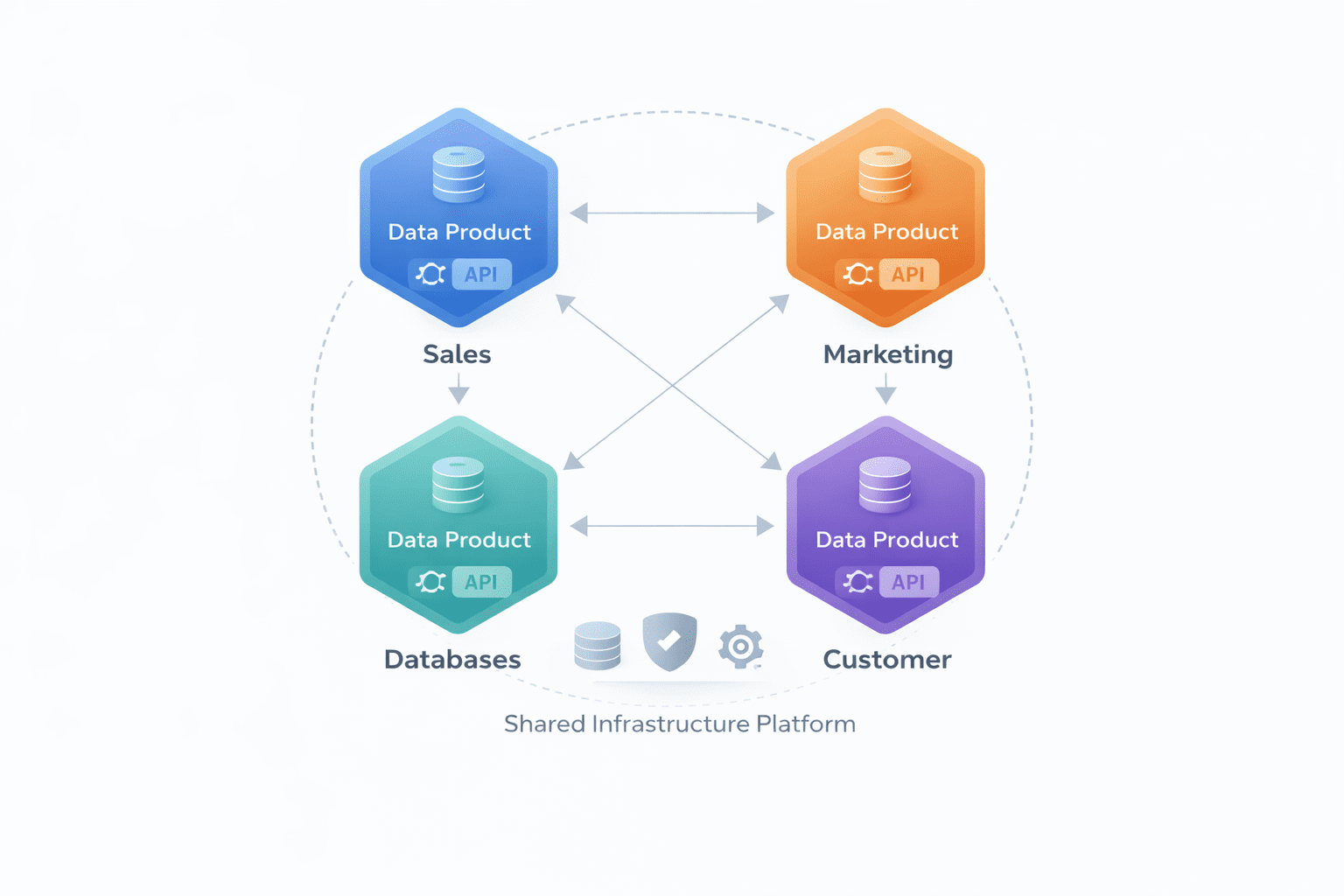
Finally, there is **Data Mesh**. This is not just a technology. It is an organizational model. It says that the central data team is a bottleneck. Instead, the teams that create the data should own it. They are responsible for serving it as a clean, reliable “data product.” It’s about decentralizing ownership to scale effectively.
The foundation of your AI factory is this: clean data, stored in a well-designed system. Without it, your factory will produce nothing but expensive garbage.
Part 2: The Assembly Line - From Model to Production
Once you have clean materials, you need an assembly line. An AI model in a developer's notebook is just a prototype. It's not a product. The real value comes when it's part of a production system.
As tech lead Mike Huls says, data science becomes impactful when it is treated as a core part of a larger system, not as an isolated activity. This means building data pipelines, APIs, and user interfaces. It requires robust engineering.
Look at how Google's Gemini models are being used. It's a perfect example of a modern AI assembly line. A recent project shows a multi-step workflow. First, Gemini detects all the illustrations in a photo of a book page. It draws a box around each one.

Next, the system crops each illustration out. Then, it sends these individual images to an editing model called Nano Banana. The model restores the image. It removes paper grain, corrects distortions, and cleans up noise. Finally, it can colorize the black-and-white drawing or even transform it into a photorealistic movie still.

This isn't one magic step. It’s a chain of specialized tasks. Detect. Crop. Restore. Transform. This is what a production AI workflow looks like.
These assembly lines are being built for some of society's biggest challenges. Take federal permitting for infrastructure projects. It's a slow, document-heavy process. It can take years. OpenAI has partnered with the Pacific Northwest National Laboratory (PNNL) to fix this. They are using AI coding agents to read technical reports, verify facts across sources, and draft environmental impact statements. The potential is huge: a 15% reduction in drafting time. This is AI as a tool to augment skilled human workers, freeing them up for high-level judgment.
These workers are AI Agents. They are the new workforce on the factory floor. But they need tools to do their jobs. An entire ecosystem is emerging around agent platforms like OpenClaw. There's **ClawHub**, a marketplace for new skills. There's **Lobster**, a tool to build repeatable workflows. And **memU**, a framework for long-term memory. AI agents are becoming more than chatbots. They are becoming persistent, capable systems.
Part 3: The Factory Manager - Orchestration is the Future
So you have clean data and a well-engineered assembly line. What's missing? A smart factory manager. Someone to oversee the whole operation. This is the final and most important piece: orchestration.
The future of AI is not one giant, all-knowing model. The future is a system of many specialized models working together. The winner will be the one who can best orchestrate them.
This is the big idea behind Perplexity's new product, "Computer." For $200 a month, it gives you an AI agent that manages 19 different models from OpenAI, Google, Anthropic, and others. You give it a complex goal, like "plan a multi-day trip to Italy." Computer breaks it down. It might use Google's Gemini for deep research on cities. It might use Nano Banana to generate images of hotels. It delegates each subtask to the best model for the job. It is the factory manager.

This shift to orchestration is what some are calling Industry 5.0. Industry 4.0 was about connecting technologies. Industry 5.0 is about orchestrating them to augment human potential. It's about moving beyond simple efficiency to create new value.
A stunning example of this comes from the world of logistics. Scheduling trucks in a large network is an incredibly hard problem. Standard optimization solvers often fail. Pure Reinforcement Learning (RL) also struggles. The action space is too big.
A new hybrid approach shows the way forward. It combines two types of AI. A Multi-Agent Reinforcement Learning (MARL) system acts as the high-level strategist. It looks at the whole network and decides the flow of goods. It's the fleet manager shouting, “Send 5 trucks to the North Hub!”
Then, a classical Linear Programming (LP) solver acts as the dock worker. It takes that high-level order and figures out the details. Which specific packages go on which specific truck? This is a “bin packing” problem it can solve perfectly. The RL agent handles strategy; the LP solver handles execution. This is brilliant orchestration.

What It Means
The hype around single AI models is fading. Building a demo is easy. Building a reliable, valuable AI system is hard.
We must be skeptical of grand claims. In the battery industry, a company called Donut Lab is making huge promises about a breakthrough technology. But experts are cautious. As they say, "extraordinary claims require extraordinary proof." The same is true in AI.
Real progress is not a sudden miracle. It is the result of disciplined, systematic work. It starts with a foundation of clean data. It requires robust engineering to build production-ready assembly lines. And it culminates in the art of orchestration, managing complex systems to create real-world value.
Stop looking for the magic box. Start thinking like a factory builder. That is the future of AI.