March 12, 2026: AI Is Getting a Job. Here's Its Resume.
AI is graduating from lab experiments to real workplaces. From healthcare to finance, autonomous agents are getting hired and delivering measurable results.
Today's Key AI Stories
- Nvidia launches Nemotron 3 Super, a powerful and efficient hybrid model built specifically for AI agents to perform complex tasks.
- Google's medical AI, AMIE, proves safe and highly accurate in a real-world clinical study, boosting patient trust.
- Ai2's MolmoBot shows that robots trained entirely in cheap virtual simulations can outperform those trained on expensive real-world data.
- Manulife is deploying AI agents across its core financial operations, projecting over $1 billion in value from AI by 2027.
- Wayfair and Rakuten are using AI to automate e-commerce catalog fixes and slash software bug recovery times by 50%.
- The tech industry is building the foundation for AI agents, giving models the ability to use tools and operate computers autonomously.
AI Is Clocking In for Its First Real Job
For years, AI has felt like a brilliant student. It aced its exams. It could write essays and paint pictures. But it lived in the lab. It was all potential, no practical experience.
That's over. AI is graduating. It's leaving the research lab and entering the workplace. It's not just a chatbot anymore. It’s becoming a doctor's assistant, a factory worker, a financial analyst, and a software developer. Today, we're not talking about future possibilities. We're looking at AI's resume. It’s already getting hired.
Part 1: The New Engine for Work
Every revolution needs an engine. The industrial revolution had the steam engine. The digital revolution had the microchip. The AI workforce has a new engine, too. And Nvidia just built it.
Meet Nemotron 3 Super. Don't let the name fool you. This isn't just another large language model. It's an engine designed for work. Specifically, for AI agents.

Think of it like this. Old models were generalists. They knew a little about everything. Nemotron 3 Super is different. It uses a hybrid design. It combines multiple types of AI architecture. It's like having a team of specialists for every task.
One part is a Transformer, great at understanding language. Another part is a Mamba, which is incredibly fast and efficient. And it uses a system called Mixture-of-Experts (MoE). This means it only activates the parts of its brain needed for a specific problem. The result? It's incredibly fast. It delivers 4x faster performance on Nvidia's new Blackwell chips. It has a massive 1-million-token memory. And its throughput crushes competitors.
Why does this matter? Because work requires speed and efficiency. A chatbot can take its time. An AI agent running a factory or analyzing financial data cannot. Nemotron is built for the high-volume, high-speed world of real work.
Part 2: AI's First Day on the Job
With a powerful new engine, AI is now qualified for many roles. We are seeing it get hired across industries. From the sterile environment of a hospital to the dusty floor of a construction site.
The Doctor's Assistant
One of the most high-stakes jobs is in healthcare. Could an AI really work with patients? Google just gave us a stunning answer: yes.
They tested their AI, AMIE, in a real-world clinical study. Patients talked to the AI before seeing a human doctor. The AI asked questions, gathered history, and reasoned about possible conditions.
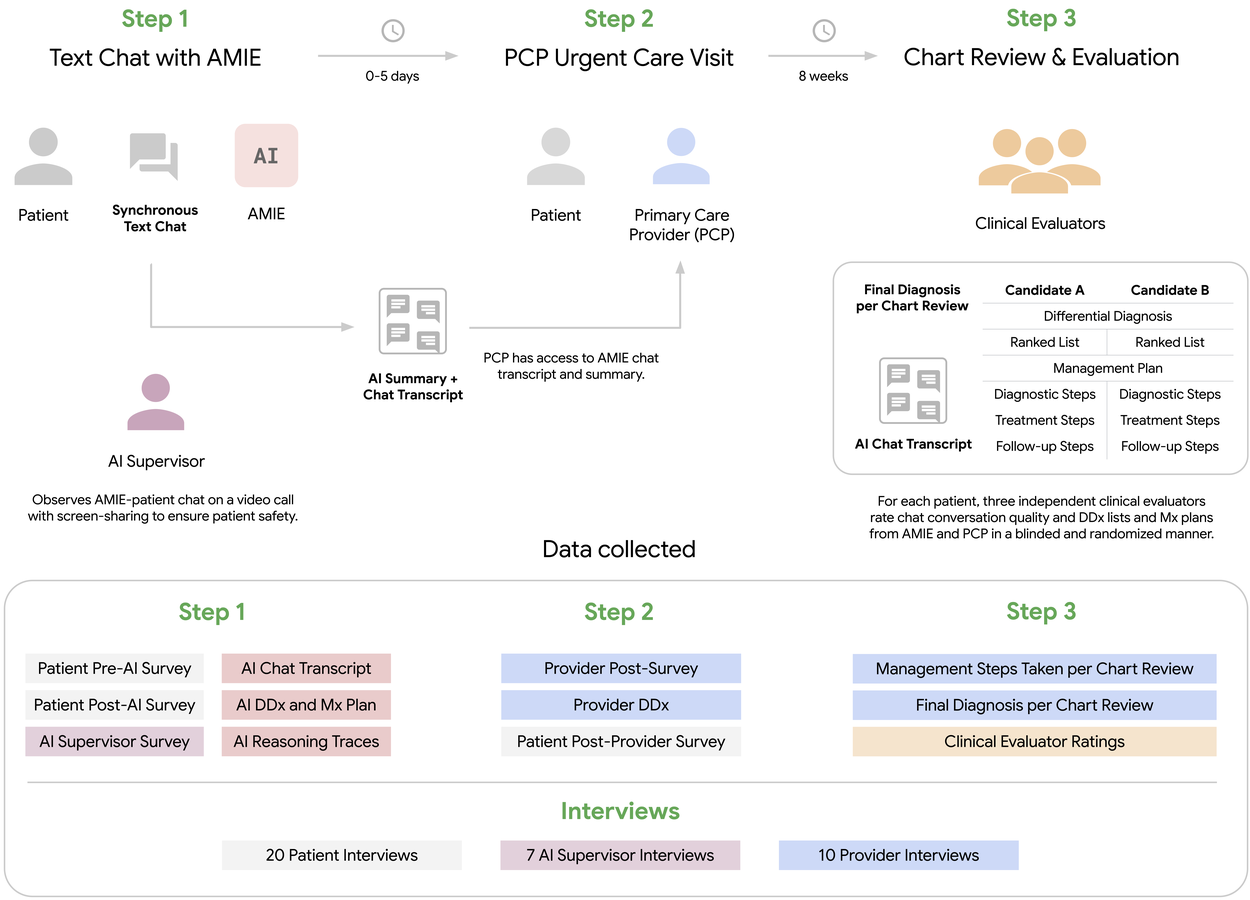
The results were incredible. First, it was safe. Not a single interaction had to be stopped by human supervisors. Second, it was accurate. In 90% of cases, the final diagnosis was in AMIE's list of possibilities. Third, patients trusted it. After using AMIE, patient trust in AI actually increased.
AMIE is not replacing doctors. It's becoming the ultimate assistant. It does the prep work. It organizes information. It allows the human doctor to be better prepared and more focused on the patient. This is AI's first job in the clinic.
The Factory Worker and The Driver
Teaching an AI to talk is one thing. Teaching it to interact with the physical world is much harder. Training robots is famously slow and expensive. You need thousands of hours of real-world data.
Or do you? The Allen Institute for AI (Ai2) just showed a better way. They built MolmoBot, a robot arm trained entirely on *synthetic* data. They created a virtual world and let the robot practice millions of times in a simulation.

The result? It's cheaper. It's faster. And incredibly, it's *better*. MolmoBot achieved a 79% success rate on real-world tasks. A similar model trained on expensive real-world data only managed 39%. This is a breakthrough. It makes building physical AI accessible to everyone.
And companies are already putting these AI workers into dangerous jobs. A new partnership between ADLINK and Noble Machines aims to build human-like robots for mining, construction, and energy plants. These robots, powered by AI, can handle heavy loads in environments too risky for people. Meanwhile, Qualcomm and Wayve are teaming up to put a unified AI driving layer into cars, accelerating the path to smarter vehicles. Physical AI is no longer science fiction. It's a new class of worker.
The Corporate Operator
AI is also taking on office jobs. And it's having a huge impact. The insurer Manulife is deploying AI agents across its core financial workflows. These agents can gather data from multiple systems and prepare summaries for employees. The company is so confident in this new workforce that it expects AI to generate over $1 billion in value by 2027.
At e-commerce giant Wayfair, AI is tackling a massive, tedious job: cleaning up the product catalog. An OpenAI model is now correcting millions of product tags, leading to more clicks and better sales. At the same time, Rakuten is using OpenAI's Codex to help its developers. The AI reviews code and helps with root-cause analysis, allowing them to fix issues 50% faster.
These are not flashy demos. This is AI embedded deep in the core operations of major companies, delivering measurable results.
Part 3: What This Really Means
This is more than just a trend. It's a fundamental shift in what AI is and what it can do. Three big ideas stand out.
The Shift from Model to Agent
A 'model' is like a brain in a jar. It can answer questions. It can write. But it can't *do* anything. An 'agent' is different. An agent has hands. It can use tools. It can operate a computer, browse the web, or run code.

News from OpenAI shows they are building the infrastructure for these agents. They are giving models a 'shell tool,' which is a command line for a computer. This is the crucial step. It turns a thinker into a doer. The AI at Manulife isn't just describing a workflow; it's executing it. This is the difference between an advisor and an employee.
The Training Ground Is Now Virtual
The second big idea is how these agents are trained. The Ai2 MolmoBot story is huge. It proves that we can train highly capable physical AI in a simulation. The constraint is no longer collecting expensive real-world data. The constraint is designing better virtual worlds. This dramatically lowers the cost and speeds up development. It democratizes the ability to build robots that can see, understand, and act.
The New Human-AI Partnership
Finally, this is not a story about replacement. It's a story about partnership. The doctor with AMIE is better prepared. The developer at Rakuten is freed from tedious bug hunting to focus on bigger challenges. The Wayfair employee now manages an AI system that improves the entire catalog, instead of manually fixing one product at a time. Humans are moving from being laborers to being managers and conductors of AI systems. Our job is becoming to give the AI workers the right goals and verify their work.
Conclusion: AI's Career Is Just Beginning
AI has graduated. Its resume is already impressive, with experience in healthcare, manufacturing, finance, and technology. And this is just the beginning.
The engine is getting more powerful. The training is getting cheaper and faster. And the applications are moving from the digital to the physical world. The question is no longer *if* AI will be a core part of our workforce. The question is how quickly we can adapt. AI is clocking in. The world of work will never be the same.